
Worldcoin Tokenomics
Version:
Mission: Building a global identity and financial network
The mission of World is to build the world’s largest identity and financial network as a public utility, giving ownership to everyone. The project’s goals regarding the Worldcoin token, WLD, are as follows:
- The majority of WLD tokens will be claimed by individuals simply for being verified unique humans.
- The majority of humans alive today will claim WLD tokens, which may result in WLD becoming the most widely distributed digital currency.
- The WLD token, alongside World ID, will be used for protocol governance.
- The WLD token will form the basis of the largest anonymous identity and financial network.
Introducing WLD
WLD is designed as a cryptocurrency with governance properties, with the goal of eventually empowering users by giving them a say over the future of the protocol. Beyond conventional “one-token-one-vote” governance mechanisms, the introduction of World ID paves the way for “one-person-one-vote” mechanisms. These two mechanisms can be combined in many ways to enable new ways of governance. While World Foundation currently acts as the steward of the protocol, it plans to solicit proposals and interface with community-governance projects on how World ID and the WLD token should interact in World’s future governance model.
The community of users may determine the token’s utility for governance, but a few other use cases could emerge. For example, users may decide to use WLD within the World Network ecosystem to access features within World App or another wallet app, such as tipping, buying and selling goods, or signaling their support for causes or initiatives.
World Foundation is currently governing the project and is working toward progressively decentralizing governance and the ecosystem. The goal of decentralization will be aided by World Foundation’s unique approach of giving the majority of the WLD token supply to participants of World Network—simply for being humans.
The WLD Token
Launch Date | July 24, 2023 |
Network Information | Worldcoin (WLD) is an ERC-20 token on Ethereum Mainnet. |
Address: Ethereum | |
Address: World Chain | |
Address: Optimism | 0xdC6fF44d5d932Cbd77B52E5612Ba0529DC6226F1 Between July 24, 2023, and October 17, 2024, Optimism was the main venue for access and use of WLD. While WLD remains available on Optimism, the main venue for access and use is now World Chain. |
Upgradability | None. No control, except inflation starting 15 years after token launch (see Inflation below). |
Token allocation entity | World Assets, Ltd., based in the British Virgin Islands. World Foundation is its sole member and director. |
Initial supply cap | 10B WLD tokens (also see Inflation below) |
Inflation | Any inflation of the WLD supply beyond the initial 10B token amount can only start, at the earliest, 15 years after launch (specifically, on July 24, 2038, 4am UTC). The rate of inflation is to be determined by protocol governance. The allocation of any newly-minted tokens is to also be decided by governance. The inflation cap, enforced by the WLD token smart contract, is 1.5% annually. The default inflation rate = 0%. |
Availability
Worldcoin tokens are not available to people or companies who are residents of, or are located, incorporated or have a registered agent in, the State of New York or certain other restricted territories. More details can be found in the Terms of Use, including additional restrictions on eligibility.
Safety reminder
Watch out for fake apps claiming to be associated with World, and platforms or third parties that may try to sell or provide you with fake WLD tokens! Ensure that whenever you are transacting in WLD that it has the correct token address listed above. If the WLD have been “bridged” to another chain that is not Ethereum, World Chain, or Optimism, make sure this bridged version is secure and can always be redeemed or bridged back for WLD on Ethereum, World Chain, or Optimism. World Foundation and its affiliates are not responsible for the creation, operation, or security of any bridges deployed by third parties, nor any WLD that is bridged through them.
Important User Information
Cryptocurrencies, tokens, and blockchain applications are highly risky. They are novel and rapidly-evolving technologies whose availability, usage, utility, value, and functionality is dependent on and affected by third party actors, market forces, regulatory environments, and emergent or changing technologies and behaviors. These factors create significant complexity and introduce new and unanticipated risks or consequences. WLD may never increase in value and/or utility, or it may lose all value and/or utility. For more information, visit https://world.org/risks.
WLD Token Allocation
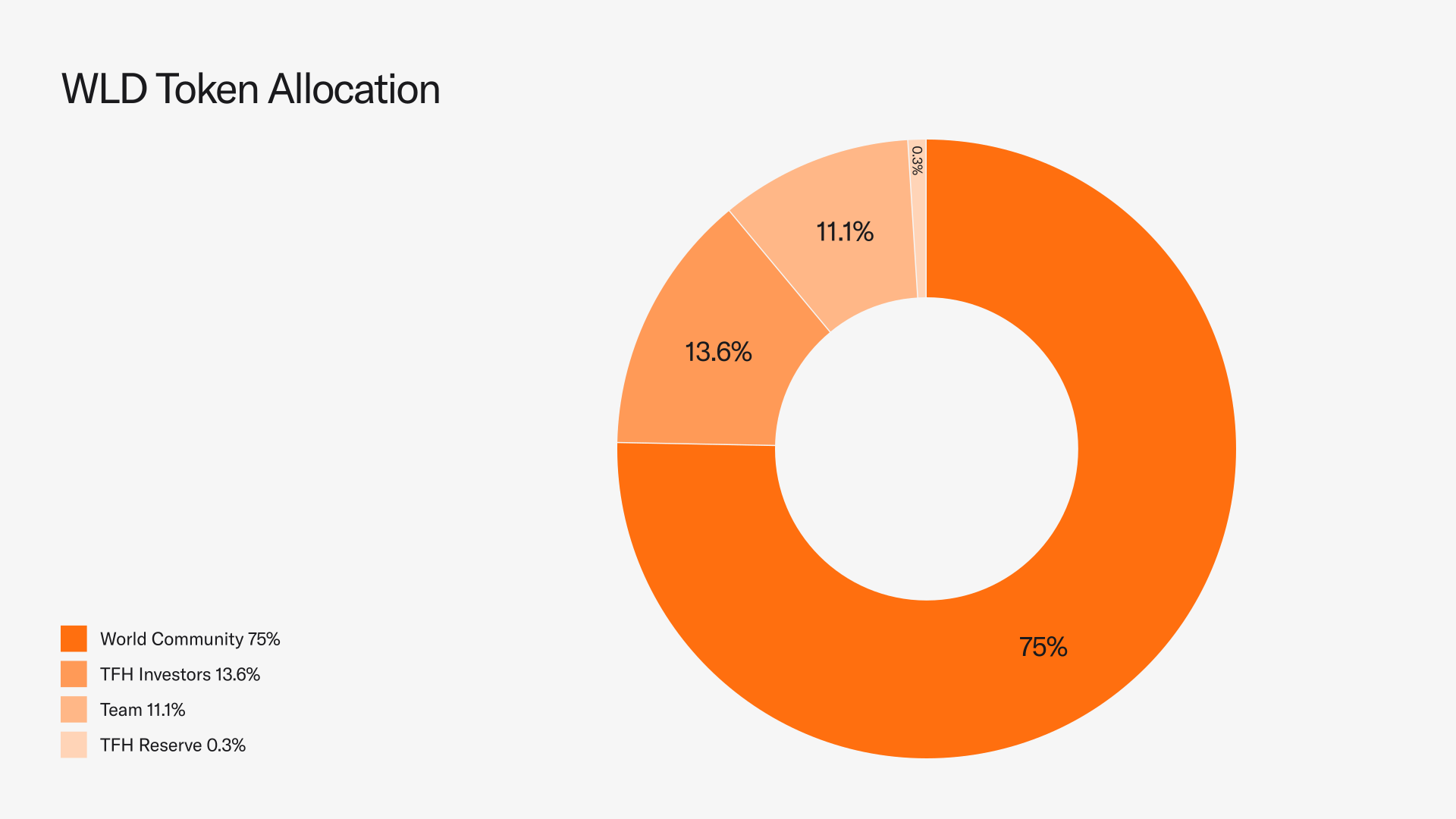
The following figure shows the allocation of WLD’s total supply to the four high-level stakeholder groups. Note that, since launch, the token allocation has changed within the 25% of the TFH Investors + Team + TFH Reserve allocation of tokens. The 75% World Community tokens are unaffected by this.
The following table provides details on the token allocation.
Percentage | Category | Description |
75% | World Community | World Foundation governs the allocation of these tokens in line with its Articles of Association and a mandate to continue decentralizing governance of token management decision-making. Most of these tokens are allocated to users; some will be used for the ecosystem fund and network operations (details below). |
11.1% | Team | These tokens go to the TFH team and other service providers that took the steps to develop World. |
13.6% | TFH Investors | TFH investors provided funding that enabled TFH to support the multi-year pre-launch phase of World. |
0.3% | TFH Reserve | TFH retains a reserve of WLD tokens to address future needs of TFH. |
Unlocked Supply and Circulating Supply
This section discusses token lock-ups and how WLD comes into circulation. Here are two terms to understand:
- Circulating supply denotes the total amount of WLD tokens that are freely circulating, meaning they do not have any specific transfer restrictions imposed upon them, and are not subject to the protocol’s governance discretion. This also includes tokens that could be acquired by external parties at any time, e.g., liquidity positions.
- Unlocked supply denotes the total amount of WLD tokens that are either part of the circulating supply or are unlocked but subject to the protocol’s governance discretion on their rate of release into the circulating supply.
Unlocked Supply Schedule
An important feature of the unlocked supply schedule is that (a) team and investor tokens are subject to lock-ups, while (b) tokens claimed by users are not locked up. The following figure shows the 15-year WLD token unlock schedule. Importantly, governance will determine the rate at which WLD tokens from the World community category are introduced into the circulating supply. This will depend on several factors, particularly the speed at which the number of World users grows. Thus, the unlocked supply represents an upper bound on the maximum circulating supply.
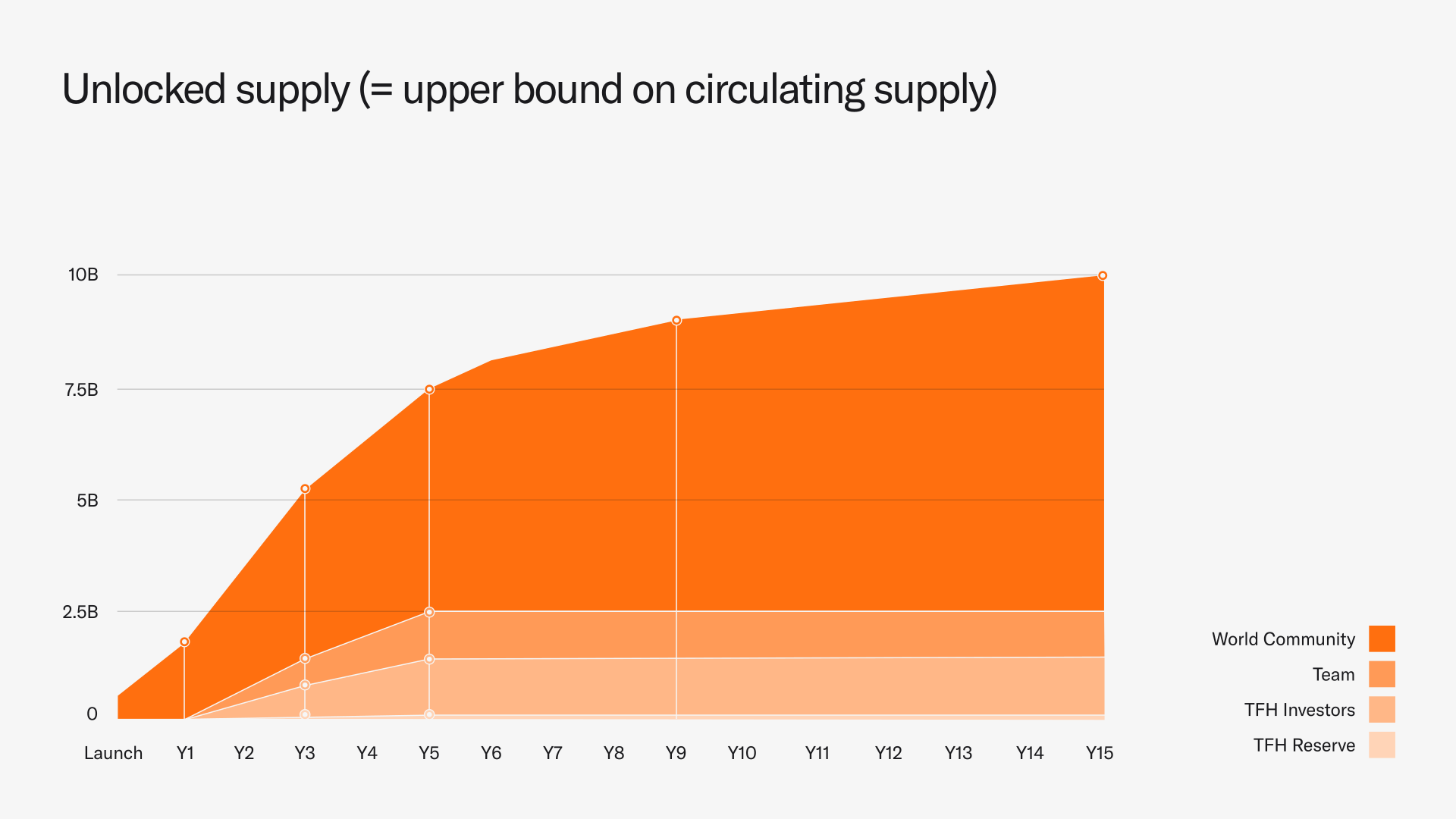
Note: For simplicity, the figure above assumes that the tokens contained in the TFH Reserve unlock according to, a one-year full lockup starting 2025-04-27 plus two years of linear unlock (see below). Given that these tokens are currently unassigned, they may be subject to additional lock-up periods and may unlock somewhat later than shown in the figure. A live version of the unlocked schedule can be found on Dune.
Below are details about the unlocked supply schedule for each category of recipient:
World Community Tokens
Ahead of launch, all 7.5B WLD tokens allocated to the World Community were minted. However, the vast majority of those tokens unlock over a 15-year span (details below). This unlock schedule constrains the pace at which these tokens can be made available for ecosystem participants. The unlock schedule of tokens is enforced by four smart contracts (1,2,3,4). Importantly, the tokens allocated to users and operators are not locked up.
The WLD token amounts shown in the following table unlock across the specified periods. During each period, an equal number of tokens are unlocked each calendar day.
Time Period | Amount of WLD Unlocked During Period | Cumulative WLD Unlocked at End of Period |
At Launch | 0.5B WLD | 0.5B WLD |
Launch – End of Year 3 | 3.5B WLD | 4B WLD |
Start of Year 4 – End of Year 6 | 1.75B WLD | 5.75B WLD |
Start of Year 7 – End of Year 9 | 0.875B WLD | 6.625B WLD |
Start of Year 10 – End of Year 15 | 0.875B WLD | 7.5B WLD |
Note: World aims to scale the network to every human. As the project grows, the number of people who are not part of the community necessarily becomes smaller. Given these dynamics, a substantial quantity of tokens are available for the World community within the first few years after launch, when the number of people who can join is highest and the rate of growth is the fastest. This is why 4B of the World Community tokens unlock over the initial three years. However, the rate at which these tokens enter the circulating supply depends on the speed of the network’s growth.
TFH Team and Investor Tokens
The tokens allocated to TFH investors were contractually fully locked up for 12 months after those investors exercised their respective token warrants (which they were able to do at launch). The team tokens had the same 12-months full lockup in place. After the full lockup period, approximately 80% of the TFH team and investor tokens started unlocking linearly over a 48-month period while approximately 20% unlock linearly over a 24-month period. Unlocking for nearly all of these tokens therefore concludes by the end of July 2028—five years after protocol launch. Originally, all unlock schedules were over 24 months, but they were extended to 48 months for the majority of tokens in July 2024. The World Foundation previously shared information about these unlocks (see here), as this very gradual unlock schedule is longer than that of many projects and aligns with the long-term nature of World’s mission. Note that team members’ tokens may additionally be constrained by vesting schedules, which have their own timelines, typically tied to a person’s tenure at TFH.
TFH Reserve
The tokens in the TFH Reserve are contractually locked up for at least one year of full lockup plus two years of linear unlock from the time they are allocated. The exact lock-up period will depend on when these tokens are allocated.
Circulating Supply at Launch
Figure 4.2 shows the amount of unlocked WLD tokens over time. This is different from circulating supply, which excludes unlocked WLD tokens that are held in the Foundation’s treasury but have not been allocated for any specific purpose.
The circulating supply of WLD primarily grows with network size and usage. At launch, there were about 2M humans who had verified and were allocated a total of 43M Beta WLD tokens during the pre-launch phase of the project. In line with World’s goal of creating a network of as many humans as possible, the circulating supply of WLD was quite low at 100.7M WLD (1% of total supply), consisting of the following parts:
-
700k WLD tokens had been migrated by users from the pre-launch phase at launch. The remaining 42.3M WLD from the pre-launch phase remained available for migration for a period of time after launch.
-
100M WLD tokens had been loaned to trading firms operating outside of the US.
Since launch, the circulating supply of WLD has grown steadily. As of April 28, 2025, it stands at about 1.3B WLD (i.e., 13% of total supply). See the dune dashboard for live numbers.
Foundation’s Token Allocation Goal
Until the protocol is self-sufficient, the World Foundation acts as the steward of the World Community tokens. As part of its role, the Foundation has allocated those tokens towards three purposes: (1) user tokens, (2) network operations, and (3) an ecosystem fund.
World’s evolution over time may be affected by a variety of factors, each of which could be significant. These factors include the number of Orbs deployed in the field, the number of new verifications per week, the activity of World’s users, the number and location of merchants, platforms, developers, and others seeking to utilize the functionalities of World, future governance decisions, and numerous other known and unknown factors. Therefore, the final allocation of the World Community tokens cannot yet be determined. Nonetheless, taking into account the project’s objectives and current scale, the World Foundation has formulated an aspirational token allocation goal, as shown in the following figure:
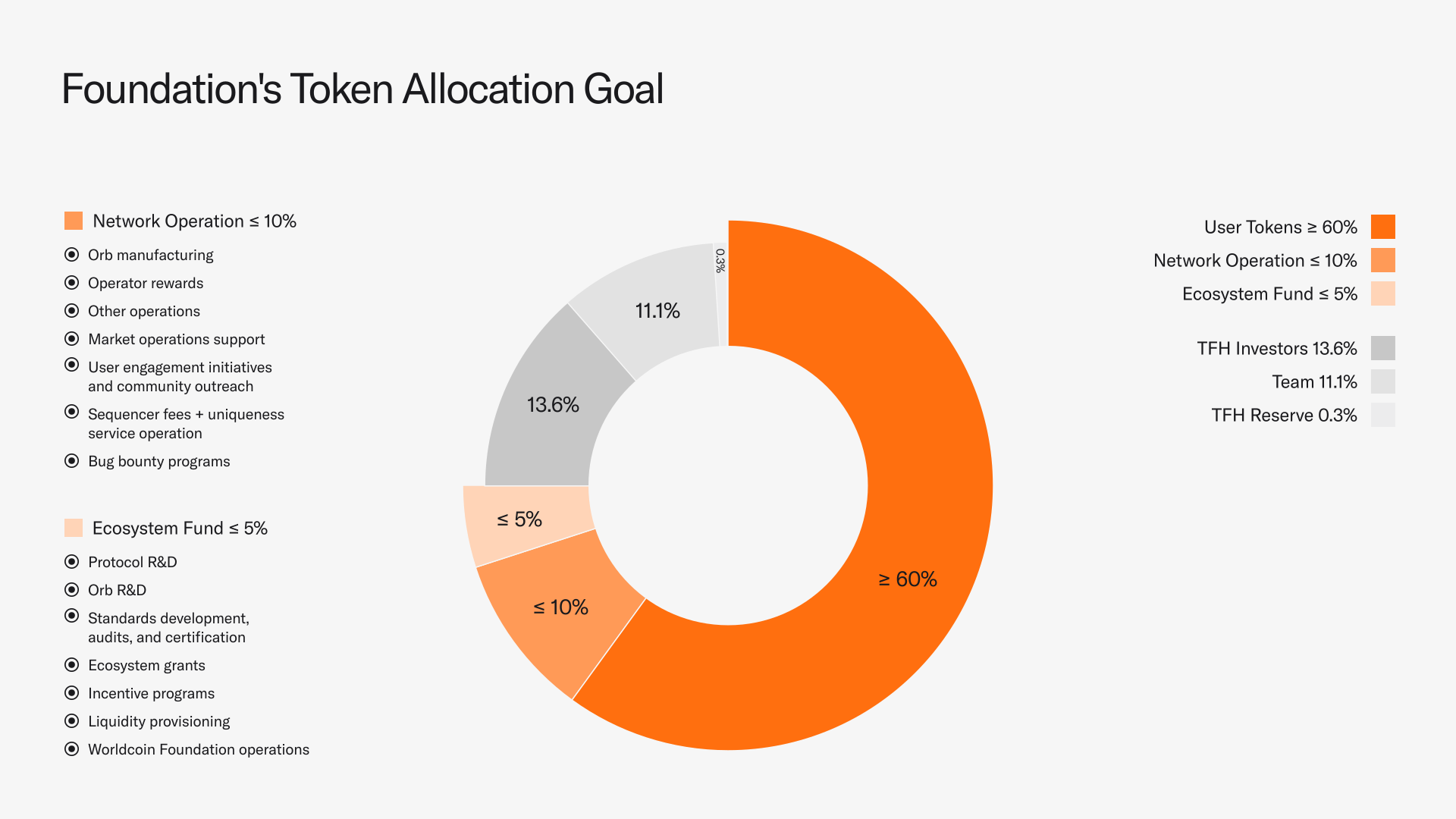
World Foundation seeks to maximize the number of WLD tokens allocated to users in line with the various factors that affect World Network’s growth. This may mean that the Foundation allocates fewer tokens to network operations and the ecosystem fund over time than shown in the above figure.
User Tokens (target allocation: ≥ 60%)
Worldcoin’s tokenomics is unique in that the majority of WLD tokens will be freely available to claim by individuals over time in the form of user tokens (previously known as “user grants” or the “WLD airdrop”). Individuals can claim these tokens simply for engaging in World Network and verifying their unique humanness. Because of this, the circulating supply of WLD primarily grows with network size and usage.
Given that equality is one of the project’s guiding values, there was not a large one-time airdrop at launch, as such an event would have likely resulted in tokens flowing to a small group of people. Instead, the availability of WLD tokens is based on the following three principles:
-
Unique humanness. Every verified unique human is eligible to claim user tokens (subject to the availability noted above).
-
Fairness. At any given point in time, all verified individuals, across all applicable countries, can claim the same amount of tokens (subject to availability).
-
Incentives: User tokens are given out over time, and the claimable user token amount decreases over time. This gives users an additional incentive to join the network early and to regularly engage with the protocol, thereby addressing the cold-start problem inherent to launching a new network.
The user tokens are not an investment. If you already have an eligible credential (see below) attached to your World ID, you may claim user tokens without providing anything of value to World as the claim is in and of itself a simple check (using zero-knowledge proofs) to determine that you are in fact eligible. No appreciation or receipt of value is guaranteed or implied–and you don’t have to claim user tokens at all to participate in World Network.
How users can claim WLD tokens
To be eligible to claim user tokens, a user needs to have a credential attached to their World ID that is recognized by the protocol for the claiming of user tokens. Currently, two credentials are recognized for this purpose. The first is the proof of human credential, which individuals obtain by verifying their uniqueness at an Orb; this automatically attaches the credential to their World ID. The second is the passport credential (or in some countries a government ID credential), which individuals can attach to their World ID by connecting their phone to a compatible NFC-enabled government issued ID, such as a passport. Note that these credentials may not be available in some jurisdictions.
Eligible individuals can then make a claim for the following two types of user token amounts via a compatible app, such as World App, by checking if their credential is in the protocol:
-
First User Token Amount: 24 hours after the credential is added, they can claim their first user token amount. As of August 1, 2025, the first user token amount is 25 WLD for the proof of human credential and 12.5 WLD for the passport credential. The amounts are expected to decrease over time.
-
Recurring User Token Amounts: Starting one month after the credential is added, individuals can claim their first recurring user token amount. Each recurring user token amount is available to claim for one month to every (eligible) individual in the world. Recurring user token amounts are the same for everyone at a given point in time but decrease over time. The recurring amount for August 2025 is 3.22 WLD for the proof of human credential and 1.61 WLD for the passport credential. The ability to claim recurring user token amounts does currently not expire, though governance could change that at a later time.
If the same individual has attached both the proof of human and the passport credential, they can claim both of the respective (first and recurring) user token amounts. For example, an individual who attaches both credentials in April 2025 can claim a total first user token amount of 25 + 12.5 = 37.5 WLD.
For a user who becomes eligible today, one can compute how much WLD they may be able to maximally claim over the following year. To do this, one fetches the first user token amount and the currently configured future recurring user token amounts for one year (see Technical Information) and sums them up. The Worldcoin Mini App in World App currently displays the result to the user as their total user token amount to abstract away the intricacies of the schedule of recurring amounts.
As of 2025-08-01, the future recurring user token amounts (as currently configured in the smart contract) are as follows. Note that governance may change these amounts.
Year | Month | Recurring user token amount, proof of human credential (WLD) | Recurring user token amount, passport credential (WLD) |
2025 | August | 3.22 | 1.61 |
2025 | September | 3.20 | 1.60 |
2025 | October | 3.18 | 1.59 |
2025 | November | 3.16 | 1.58 |
2025 | December | 3.14 | 1.57 |
2026 | January | 3.12 | 1.56 |
2026 | February | 2.68 | 1.43 |
2026 | March | 2.60 | 1.30 |
2026 | April | 2.34 | 1.17 |
2026 | May | 2.08 | 1.04 |
2026 | June | 1.82 | 0.91 |
2026 | July | 1.56 | 0.78 |
2026 | August | 1.36 | 0.68 |
Unclaimed WLD tokens remain in the World community pool. Importantly, “claim” refers to the process described above by which user token amounts are received and is not intended to create or imply any legal relationship between any individual and World Foundation or any other entity.
Governance over user token amounts. The user token amounts are set by the protocol’s governance. Currently, governance is implemented via World Foundation, but it is expected that over time, governance will be increasingly decentralized. This means that governance could also alter the emission mechanism for user tokens. For example, once the system has stabilized, governance may decide to automatically update the user token amounts according to some rule implemented in a smart contract.
Long-term sustainability of the user token emission. To achieve the goal of providing WLD tokens to every living human being (subject to availability and eligibility), governance may also decide to phase out the recurring user token amounts after a few years and only keep the first amount, thereby reserving the remaining tokens for new users in the future. As explained below, governance may also decide to direct a portion of the future fee revenue from World ID fees towards user tokens. Finally, as explained above, 15 years after launch, governance may also decide on enacting an inflation rate of up to 1.5% per year, if this is deemed necessary to continue the user token mechanism into the future.
Historical note: user token reservations for unverified individuals. For a period after launch, individuals were able to reserve user token amounts prior to verification and they would receive their reserved amounts once they verified at an Orb. Reservations have now been phased out and redemptions of these reservations close in July 2025.
Historical note: User token allocations during the pre-launch phase. During the pre-launch phase of World, which lasted from May 2021 until July 2023, Beta WLD tokens were allocated to users in different stages (subject to availability). Users were able to migrate their Beta WLD to WLD at or after launch.
The remainder of this section discusses the other categories in the Foundation’s token allocation goal.
Network Operation (target allocation: ≤ 10%)
A portion of the WLD token supply allocated to the World Community is intended to be used to fund network operations. This section describes the main operational costs for the network, though this list is not intended to be exhaustive. Where necessary, these costs may be covered by World Foundation converting a portion of WLD tokens allocated to network operation into fiat or other currency.
Areas and responsibilities for network operations. The World Foundation is the steward of the World project, supporting and growing the community. The World Foundation owns the IP for the World ID protocol, the Orb, World Chain, and the Worldcoin token protocol. The World Foundation also governs the 75% of all Worldcoin (WLD) tokens that have been allocated to the World Community. In line with the project goals, the Foundation is allocating part of these tokens towards network operations and ecosystem building.These include the operation of the World ID sign up sequencer and uniqueness services, entities supporting World Chain, user engagement, and community outreach.
Other areas of network operations are the responsibility of ecosystem contributors. These areas include Orb manufacturing and operations. One of these ecosystem contributors is Tools for Humanity (TFH), the initial development company that launched World Network.
The World Foundation plans to further decentralize network operations, for example, through additional service providers and decentralized structures that ensure the long-term sustainability of the operations of the network.
Orb Manufacturing
Part of the WLD token supply is used to fund ongoing manufacturing costs. To this end, World Foundation engages TFH to oversee manufacturing of the Orb. In the future, other service providers may also be engaged to manufacture the Orb or devices similar to the Orb.
Orb Operations
Orb Operators are independent ecosystem participants who operate the Orbs and receive Operator rewards for verifying individuals at the Orb. It is important that Operators provide users with a high-quality experience by educating them about the project and supporting them during the verification process. To align the Operators’ financial interests with the objectives of World, Operator rewards are impacted by measures of sign-up quality.
To ensure the long-term financial viability of World (given the Foundation’s long-term goal of deploying 50,000 Orbs), competitive mechanisms have been trialed to determine fair Operator rewards. This also encourages Operators to innovate and quickly adapt to the changing needs of the project. The vast majority of Operator rewards is paid in WLD tokens (subject to the availability noted above), while a small share is paid in USDC.
Other Operations
Part of the WLD token supply is used by World Foundation to fund other operational costs, which includes logistics associated with Orb deployment, production of equipment provided to Operators, etc.
Market Operations Support
Part of the WLD token supply will be used by World Foundation to fund market operations support, which includes the recruitment, training and coordination of the network of Operators around the world.
User Engagement Initiatives and Community Outreach
When launching in a new country or region, part of the WLD token supply can be used by World Foundation to fund user engagement initiatives and community outreach programs (e.g., partnering with local organizations).
Sequencer and Uniqueness Service Operation
When a person verifies with an Orb, the uniqueness of their biometric information needs to be verified, and the proof of uniqueness needs to be written to the blockchain. The corresponding service is operated by World Foundation. World Foundation also supports the operation of a sequencer for World Chain that writes the state of the World Chain to Ethereum. Part of the token supply is allocated toward covering the cost of these services.
Bug Bounty Programs
While the hardware and software have been extensively audited by external security auditing companies (see the Orb audit and protocol audits), additional bug bounty programs have been set up for the smart contracts and other software. These bug bounty programs may also function as tools for the progressive decentralization of the project.
Ecosystem Fund (target allocation: ≤ 5%)
The ecosystem fund is intended to be used by World Foundation to support activities for the continued development and decentralization of World. These costs are largely independent of the network size or the size of the on-the-ground operations.
Protocol R&D
Some funds are used by World Foundation for continued development of World and related software. This includes, for example, the development of the World ID protocol, World Chain, and may in the future include the development of client apps.
Orb R&D
Ecosystem funds are also used for continued research and development of Orb hardware and software, including security mechanisms and new features.
Standards Development, Audits, and Certification
Some funds are used by World Foundation to foster standardization of the different parts of World, including different wallet apps, the Orb and the on-chain protocol. Standards help decentralization by making it easier for different parties to become part of the network. In the future, some funds are expected to be used for audits (e.g., of new biometric devices or new wallet apps) and certifying new service providers.
Ecosystem Grants
Some funds are used for ecosystem grants, which are issued for the development of new protocols, systems and integrations that are part of World, as well as for additional research and development.
Incentive Programs
Some funds are used for programs that directly incentivize activities by persons, companies and protocols that contribute to the ecosystem’s growth.
Liquidity Provisioning
World Assets,, Ltd. entered into loan agreements with several trading firms operating outside of the US. These loans enable trading firms to independently assess and provide liquidity for WLD tokens.
As of 2025-04-28, these entities collectively hold loans worth 13M WLD. Out of this amount, 10M WLD expire on 2025-06-14, 1M WLD expire on 2025-09-26, and 2M WLD are currently not marked for expiry. The loans must be repaid in full in WLD – in particular, there is no call option.
World Foundation Operations
Part of the ecosystem fund will be used to fund a small staff working at World Foundation, along with associated operational costs (e.g., legal, administration).
World ID Fees
World ID is a protocol enabling a global, privacy-preserving identity network. At its core is the proof of human credential provided by the Orb. Additionally, the World ID protocol enables any entity (e.g., enterprises or governmental institutions) to create a new World ID Credential (e.g., a credit report or a university certificate), which individuals can attach to their World ID. Individuals can then share things about themselves without revealing their real identity. For example, Orb-verified individuals can prove to an application (aka a relying party) “I am a unique human”, while individuals who have added a passport credential can prove “I am over 18” or “I am a US citizen”. Credentials can also be combined to make composite proofs, for example “I am a unique human who is over 18”, without revealing any other information. Given the importance of knowing whether a credential (like the age credential) has only been used once for a given application, it is expected that most World ID proofs will include the proof of human credential in this way.
Applications that integrate World ID can request and use such proofs, for example, to avoid bot accounts, to prevent AI impersonation and fraud, or to implement age controls. Furthermore, AI Agents may soon require a technology like World ID for humans to delegate authority to agents.
As part of its mission, the World Foundation aims to progressively decentralize the ecosystem and make the project self-sufficient. In the context of the World ID protocol, this has two primary components:
-
Incentives for credential issuers: Enable credential issuers to generate sufficient revenue such that they are incentivized to issue and maintain their credentials.
-
Protocol sustainability: Generate sufficient revenue to make the protocol sustainable.
To this end, the Foundation is currently designing changes to the World ID protocol that will enable the option to charge fees, payable in WLD, to applications using World ID proofs.
Charging Applications, not Users
World ID fees will be charged to applications, not to end users. The motivation for this is that value creation is most directly measurable by the applications. The value of World ID is realized when applications integrate it to either enhance their existing services or enable entirely new services—potentially even spawning new business models previously impossible to implement. It is therefore natural for the protocol to charge applications for consuming World ID services. Applications are accustomed to paying for the components they integrate and can be expected to recognize the value World ID brings to their offerings. This approach ensures that a portion of the value created for applications flows back to the credential issuers and the protocol.
Details on World ID Fees
World ID fees will consist of two components:
-
Credential fee: Each credential issuer (e.g., the World Foundation for the Orb credential, enterprises or governmental institutions for their credentials) will be able to set a fee for their credential, and they will receive the corresponding fee revenue. This ensures that credential issuers have an incentive to create and maintain their credentials.
-
Protocol fee: The protocol will set a base fee and additionally charge a small premium on top of the credential fee. This will ensure that enough revenue is generated to make the protocol self-sufficient.
From an application’s perspective, there will only be one World ID fee – the sum of the credential fee and the protocol fee. The World ID fee will be charged when an application (identified via a unique app id) requests a World ID proof.
Fee payment will be enforced at the protocol level. This is one of the features enabled by the private state blockchain employed by the future World ID architecture (see here for a technical background on the underlying cryptography used). Informally speaking, a private state blockchain can update its internal state without anyone being able to observe it, while still being permissionless: anyone can operate a node, but certain state variables are only available within the computation of the private state blockchain itself, not observable in clear text outside of it.
Employing a private state blockchain will enable various features for the World ID protocol (e.g., World ID recovery and multi-wallet usage). Importantly, it will also store part of the application state belonging to each verified user. The World ID smart contract will programmatically check whether the fee has been paid before providing a receipt of the state change from the private state blockchain that enables the user to then generate the proof. In this way, using a private state blockchain also ensures that applications cannot circumvent World ID fees, as they cannot observe the state of the blockchain.
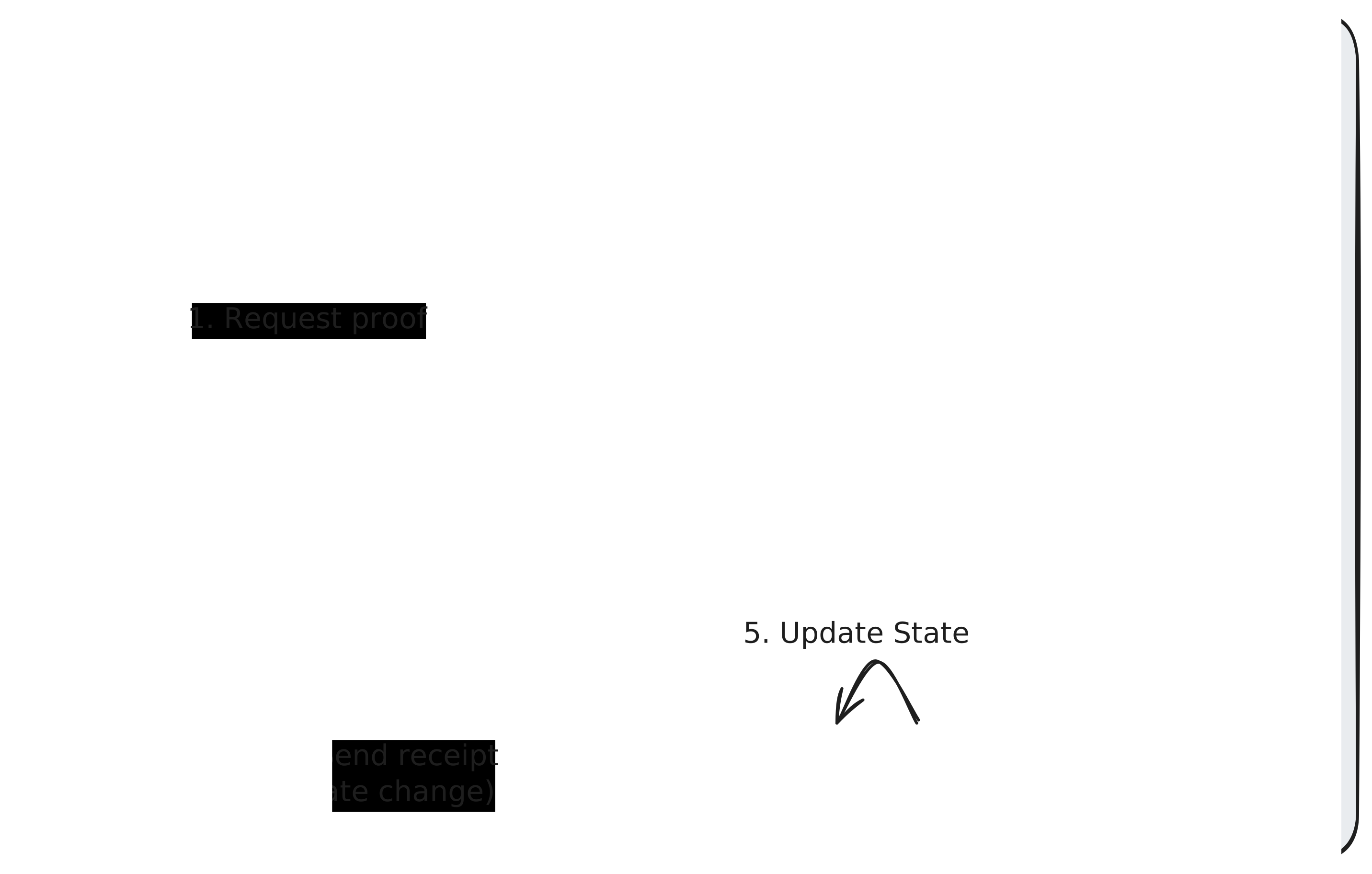
Figure 4.4 presents a high-level overview of the planned World ID fee implementation, using the example of a user who has already enrolled with a credential issuer and had their credential registered on the private state blockchain. World ID fees then work as follows: (1) An application that has integrated with World ID requests a proof (e.g., of unique humanness) from the user. (2) The user (via a World ID app like World App) decides to execute the request towards the World ID smart contract on the private state blockchain. (3) The smart contract automatically triggers the WLD fee payment from a wallet associated with the requesting application. (4) The corresponding credential fee is paid to the credential issuer wallet, and the protocol fee is paid to the protocol wallet. (5) The World ID smart contract updates its own state. (6) The World ID smart contract sends a receipt of the state change to the user. (7) The user’s app generates and sends the World ID proof to the application.
The World ID smart contract will require fees to be paid in WLD, meaning applications’ wallets on the private state blockchain must be pre-funded with WLD. Web3-native applications can directly pre-fund their wallet on the blockchain. Alternatively, applications (e.g., Web2 platforms) might use a third-party pre-funding service that handles the wallet pre-funding for them and charges the application in fiat. Either way, WLD tokens are ultimately used to pay all fees.
Pricing Mechanisms
Figure 4.4 implicitly assumes that World ID fees are paid for every World ID proof. In practice, each credential issuer will be able to choose any pricing mechanism compatible with the architecture shown in Figure 4.4. Because pricing mechanisms are implemented as smart contracts on the private state blockchain, a wide array of options becomes possible, including:
-
Per-proof: A fee could be charged for every World ID proof.
-
Per-monthly-active-user: A fee could be charged for every monthly active user (per app-id). For each user, the fee would be collected the first time a proof is requested for that user in a given month. Since the computation happens inside the private state blockchain, per-monthly-active-user pricing models can be implemented without revealing the identity of users.
-
Free tiers: The first 1000 users or the first 1000 proofs could be free.
-
Volume discounts: The per-user or per-proof fee could decrease with volume.
-
Discounts for specific applications: A credential issuer could offer discounts to specific applications (e.g., NGOs), or even offer their credentials for free.
-
Fees proportional to economic value: A credential issuer could offer multiple proof variants at different fee levels, with some variants intentionally providing a lower level of proof assurance, allowing applications to select the level that best fits their needs.
For the base fee component of the protocol fee, governance will similarly be able to decide on a suitable pricing mechanism. While several different pricing mechanisms are possible, it is likely that most applications will prefer a per-monthly-active-user fee, as it allows applications to compare that fee with the value that World ID generates for them per user per month (e.g., due to an increase in ARPU).
For composite proofs like “I am a unique human who is over 18 years old,” fee amounts could potentially depend on the combination of credentials required by a World ID proof. For example, the fee for a “uniqueness” proof could be lower than the fee for a “uniqueness + age” proof.
Fee usage
Each credential issuer will have discretion over how to use their credential fees. As for protocol fees, the World Foundation will initially govern their allocation. Over time, as governance becomes more decentralized, the World community will take over this responsibility. The community may choose to direct a portion of the fees toward continued network growth—for example, by supporting Operators or funding the User Tokens—or even decide to burn a share of the fees. As the World ID protocol grows (with more participants, more applications, and more proof verifications), more fees will be generated, which can then flow back into the ecosystem to create further growth, leading to a self-reinforcing growth mechanism.
Next steps on World ID Fees
The World Foundation is currently working on the protocol changes necessary to enable World ID fees. The Foundation expects to complete this work and run a first pilot to test the fee mechanism during Q3 2025. The Foundation believes that demonstrating a path towards World ID fees early on is important to incentivize other parties in the ecosystem to issue and maintain their credentials, and to show how the protocol can become self-sufficient.
While the Foundation prepares to launch World ID fees, its primary focus remains squarely on growing World Network. The Foundation will also continue providing ecosystem grants to support the community of mini app developers, credential issuers, and applications integrating with World ID.
Technical Information
Contracts and Addresses
Smart Contracts
Contract | Network | Address |
WLD Token Contract | Ethereum | |
WLD Token Contract | World Chain | |
WLD Token Contract | Optimism | |
Community Tokens Unlock Contracts | Ethereum | |
Recurring User Token Amounts Allocation Contract, Orb | World Chain | |
Optimism (deprecated) | ||
Recurring User Token Amounts Allocation Contract, Passport Credential | World Chain | |
First User Token Amounts Allocation Contract, Orb | World Chain | |
First User Token Amounts Allocation Contract, Passport Credential | World Chain | |
Beta WLD Token Contract (deprecated) | Optimism |
User token amounts can be fetched as follows: the currently active grant IDs and future recurring user token amounts can be fetched from the WLDGrant contract available at (Recurring User Token Amounts Allocation Contract).grant() where one chooses the Recurring User Token Amounts Allocation Contract corresponding to the respective credential (Orb or Passport). The current first user token amount can be fetched from API endpoint at: https://api.airdrop.world.org/v1/grants/first-claim-amount?grantId=<current_grant_id>
Main Wallets
Wallet | Network | Address |
World Foundation | Ethereum | |
Optimism | ||
World Chain | ||
World Assets, Ltd. | Ethereum | |
Optimism | ||
World Chain | ||
World Assets, Ltd. | Ethereum | |
World Chain | ||
World Assets, Ltd. Hot Wallet: Recurring User Token Amounts | World Chain | |
Optimism (deprecated) | ||
World Assets, Ltd. Hot Wallet: First User Token Amount | World Chain | |
World Assets, Ltd. Hot Wallet: Reservations | World Chain | |
WLD Vault | World Chain | |
Optimism (deprecated) | ||
Optimism – World Chain Migration | Optimism | |
World Chain | ||
World Assets, Ltd. Hot Wallet: Welcome Grants and Beta Token Migration (deprecated) | Optimism | |
World Assets, Ltd. Hot Wallet: | Optimism | |
World Assets, Ltd. Hot Wallet: | Optimism | |
Polygon Bridge | Optimism |
FAQ
How do the World Chain contracts relate to the Ethereum contracts?
The WLD token contract is deployed on Ethereum mainnet, and the token is bridged to the World Chain “layer 2” network. However, World Foundation expects that most of the activity in WLD tokens will happen on World Chain, where verified individuals receive their user token amounts. In addition, World App primarily interacts with the World Chain network. The reasons for choosing World Chain over Ethereum as the primary venue were scalability and transaction costs. A legacy bridged version of WLD also still exists on Optimism.
Who pays the transaction costs (gas fees)?
World App users generally do not currently incur gas costs; the gas fees for claiming WLD tokens, performing swaps, and other transactions are currently funded by TFH. In the future, World App could require users to pay gas fees for certain actions, e.g., transfers made to other wallets. When users verify their identity to a third-party application via World ID, this does not incur gas costs for the protocol. However, the third-party applications may charge users gas fees (depending on whether they verify the proof on-chain or off-chain) or other fees. For instance, when using the swap feature in World App, users do pay any fees incurred on third-party platforms. Users may incur gas fees for transactions that are not made through World App that are dependent on the platform and chain on which the transaction is occurring.
How are the World Community tokens stored? Do you use a custody provider?
The majority of the World Community tokens are stored in a cold wallet. Additionally, several hot wallets are used by World Foundation and World Assets, Ltd., to manage everyday operations. Tokens are typically only stored in these hot wallets for a short period of time, and these wallets only store as many tokens as needed.
Who controls the WLD token contract? Is it upgradable? Does anyone have minting rights?
The WLD token contract is not upgradable. No control can be exercised over the contract, except for setting the “minter” address in case the community decides to activate inflation. For 15 years following the launch, no address is able to mint any new tokens. After 15 years, a “minter” address (controlled by protocol governance) can mint up to 1.5% new WLD tokens per year, with governance deciding how to allocate them.
What are the involved entities and where are they incorporated?
The World Foundation is an exempted limited guarantee foundation company, incorporated in the Cayman Islands. It is “memberless,” meaning it has no shareholders or beneficial owners. Its registered office is located at Suite 3119, 9 Forum Lane, Camana Bay, George Town, Grand Cayman KY1-9006, Cayman Islands. World Foundation’s principal purpose, as set forth in its Articles of Association, is to support and encourage the growth of those building in the World ecosystem, support and foster the decentralization of World technologies and governance, hold and license intellectual property relating to the World Network, and to receive, sell, hold, loan, and spend assets to support these purposes.
World Assets, Ltd. is a company registered in the British Virgin Islands on December 7, 2022 with BVI Company Number 2113558. The World Foundation is the sole member/director of World Assets, Ltd. World Assets, Ltd.is responsible for issuing the 7.5B Worldcoin tokens (WLD) that have been allocated to the World community.
World Chain LLC is a limited liability company formed in the Cayman Islands. World Foundation is its sole member and manager. World Chain LLC is responsible for the ownership and operation of World Chain infrastructure.
More information about these entities, including incorporation documentation and equity composition, can be found at foundation.world.org/about.
Tools for Humanity (TFH) is a Delaware corporation headquartered in San Francisco, California (US), with a wholly-owned subsidiary, Tools for Humanity GmbH based in Germany. Its registered office is located at CSC 251 Little Falls Drive, Wilmington, Delaware 19808. It registered on June 26, 2019 and its legal entity number is 7487684. TFH supported World’s multi-year pre-launch phase, during which it developed the Orb, the first version of the protocol, and the World App, the first wallet for World Network, which it still operates today. It is governed entirely independently of World Foundation. Founded in 2019, TFH has grown to a team of approximately 500 people today. However, World is an open protocol that anyone can contribute to and build on.
Disclaimer
PLEASE READ THE ENTIRETY OF THIS “NOTICE AND DISCLAIMER” SECTION CAREFULLY. NOTHING HEREIN CONSTITUTES LEGAL, FINANCIAL, BUSINESS, INVESTMENT OR TAX ADVICE AND YOU SHOULD CONSULT YOUR OWN LEGAL, FINANCIAL, BUSINESS, INVESTMENT, TAX OR OTHER PROFESSIONAL ADVISOR(S) BEFORE ENGAGING IN ANY ACTIVITY IN CONNECTION HEREWITH. NEITHER THE WORLD FOUNDATION (THE FOUNDATION) AND ANY OF THE PROJECT PARTICIPANTS (TOGETHER WITH THE PROJECT PARTICIPANTS, THE WORLD NETWORK) WHO HAVE WORKED ON WORLD NETWORK (AS DESCRIBED HEREIN) OR DEVELOPERS OF WORLD NETWORK IN ANY CAPACITY WHATSOEVER, NOR ANY SERVICE PROVIDER SHALL BE LIABLE FOR ANY KIND OF DIRECT OR INDIRECT DAMAGE OR LOSS WHATSOEVER WHICH YOU MAY SUFFER IN CONNECTION WITH ACCESSING THIS WHITEPAPER, THE WEBSITE AT HTTPS:// WORLD.ORG (THE WEBSITE) OR ANY OTHER WEBSITES OR MATERIALS PUBLISHED BY THE FOUNDATION.
Crypto Products
Crypto products can be highly risky and their regulatory treatment is unsettled in many jurisdictions. There may be no regulatory recourse for any loss from transactions in WLD tokens. Any value ascribed to WLD tokens may change quickly and may be lost in its entirety. Further, the technologies comprising World Network, including the WLD token, are experimental in nature. There is no guarantee that the network will operate as planned. For more information, visit www.world.org/risks. Holding, buying, or selling WLD tokens may not be permitted where you live, and it is your responsibility to comply with all applicable laws. Worldcoin (WLD) tokens are not intended to be available to residents of the State of New York or certain other restricted territories. More details can be found at http://www.world.org/tos.
As described further below, this document contains forward-looking estimates and statements regarding the intended actions and objectives of World Foundation and World Network, based largely on current expectations and projections about future events for which the outcome is uncertain. It is therefore subject to a number of known and unknown risks, including those described at www.world.org/risks, that could cause the actual outcomes to differ materially from what is expressed or implied herein. Readers are cautioned not to put undue reliance on these future-looking estimates and statements. The content of this document speaks only as of the date thereof.
Nature of the Whitepaper
The Whitepaper and the Website are intended for general informational purposes and community discussion only and do not constitute a prospectus, an offer document, an offer of securities, a solicitation for investment, or any offer to sell any product, item or asset (whether digital or otherwise). Nothing contained in the Whitepaper or the Website is or may be relied upon as a promise, representation or undertaking as to the future performance of World Network. The information herein may not be exhaustive and does not imply any element of a contractual relationship commitment in relation to the acquisition of WLD Token, and no virtual currency or other form of payment is to be accepted on the basis of the Whitepaper or the Website. There is no assurance as to the accuracy or completeness of such information and no representation, warranty or undertaking is or purported to be provided as to the accuracy or completeness of such information. Nothing contained in the Whitepaper or the Website is or may be relied upon as a promise, representation or undertaking as to the future performance of World Network. Any agreement between any third party and you, in relation to any sale, purchase, or other distribution or transfer of WLD Token, is to be governed only by the separate terms and conditions of such agreement, and such agreement must be read together with the Whitepaper. Where the Whitepaper or the Website includes information that has been obtained from third party sources, the Foundation, their respective affiliates and/or World Network have not independently verified the accuracy or completion of such information. Further, you acknowledge that circumstances may change and that the Whitepaper or the Website may become outdated as a result; and the Foundation is not under any obligation to update or correct this document in connection therewith.
The information set out in the Whitepaper and the Website is for community discussion only and is not legally binding. No person is bound to enter into any contract or binding legal commitment in relation to the acquisition of any WLD token, and no virtual currency or other form of payment is to be accepted on the basis of the Whitepaper or the Website. Any agreement governing the sale or acquisition of WLD tokens shall be governed by a separate set of Terms of Service, available at www.world.org/tos. The Terms of Service must be read together with the Whitepaper and further information available at www.world.org/risks. In the event of any inconsistencies between the Terms of Service and the Whitepaper or the Website, the Terms of Service shall prevail.
Token Features
The native digital cryptographically-secured cryptocurrency of World Network (WLD Token) is a transferable representation of attributed functions specified in the protocol/code of World Network, designed to play a major role in the functioning of the ecosystem on World Network, and intended to be used solely as the primary utility and future governance token on the platform. The goal of introducing WLD Token is to provide a convenient and secure mode of payment and settlement between participants who interact within the ecosystem on World Network, and it is not, and not intended to be, a medium of exchange accepted by the public (or a section of the public) as payment for goods or services or for the discharge of a debt; nor is it designed or intended to be used by any person as payment for any goods or services whatsoever that are not exclusively provided by the issuer. WLD Token may only be utilized on World Network, and ownership of WLD Token carries no rights, express or implied, other than the right to use WLD Token as a means to enable usage of and interaction within World Network. WLD Token is not intended to be an investment, and no value appreciation is guaranteed or implied.
Deemed Representations and Warranties
By accessing the Whitepaper or the Website (or any part thereof), you shall be deemed to represent and warrant to the Foundation, their respective affiliates, and World Network as follows:
-
in any decision to receive and/or purchase any WLD Token, you shall not rely on any statement set out in the Whitepaper or the Website;
-
you will and shall at your own expense ensure compliance with all laws, regulatory requirements and restrictions applicable to you (as the case may be);
-
you acknowledge, understand and agree that WLD Token may have no value, there is no guarantee or representation of value or liquidity for WLD Token, and WLD Token is not an investment product including for any speculative investment;
-
WLD tokens may not always be transferable or liquid;
-
WLD tokens may not be exchangeable against any goods or services contemplated in the Whitepaper, especially in case of failure or discontinuation of the project;
-
none of the Foundation, their respective affiliates, and/or World Network members shall be responsible for or liable for the value of WLD Token, the transferability and/or liquidity of WLD Token and/or the availability of any market for WLD Token through third parties or otherwise; and
-
you acknowledge, understand and agree that you are not eligible to purchase any WLD Token if you are a citizen, national, resident (tax or otherwise), domiciliary and/or green card holder of a geographic area or country (i) where it is likely that the sale of WLD Token would be construed as the sale of a security, financial service or investment product and/or (ii) where participation in token sales is prohibited by applicable law, decree, regulation, treaty, or administrative act; and to this effect you agree to provide all such identity verification document when requested in order for the relevant checks to be carried out.
The Foundation disclaims all representations, warranties or undertakings to any entity or person (including without limitation warranties as to the accuracy, completeness, timeliness or reliability of the contents of the Whitepaper or the Website, or any other materials published by the Foundation). To the maximum extent permitted by law, the Foundation, their respective affiliates and service providers, and the World Network shall not be liable for any indirect, special, incidental, consequential or other losses of any kind, in tort, contract or otherwise (including, without limitation, any liability arising from default or negligence on the part of any of them, or any loss of revenue, income or profits, and loss of use or data) arising from the use of the Whitepaper or the Website, or any other materials published, or its contents (including without limitation any errors or omissions) or otherwise arising in connection with the same. Prospective purchasers of the WLD Token should carefully consider and evaluate all risks and uncertainties (including financial and legal risks and uncertainties) associated with the WLD Token sale, the Foundation, and World Network.
Disclaimers Relating to the WLD Token
It is expressly highlighted that WLD Token:
-
does not have any tangible or physical manifestation, and does not have any intrinsic value (nor does any person make any representation or give any commitment as to its value), and may lose its value in part or in full;
-
is non-refundable and cannot be exchanged for cash (or its equivalent value in any other virtual currency) or any payment obligation by the Foundation, the World Network, or any of their respective affiliates, and may not always be transferrable or liquid;
-
does not represent or confer on the token holder any right of any form with respect to the Foundation, the World Network (or any of their respective affiliates), or its revenues or assets, including without limitation any right to receive future dividends, revenue, shares, ownership right or stake, share or security, any voting, distribution, redemption, liquidation, proprietary (including all forms of intellectual property or license rights), right to receive accounts, financial statements or other financial data, the right to requisition or participate in shareholder meetings, the right to nominate a director, or other financial or legal rights or equivalent rights, or intellectual property rights or any other form of participation in or relating to World Network, the Foundation, and/or their service providers;
-
does not entitle token holders to any promise of fees, dividends, revenue, profits or investment returns, and are not intended to constitute securities in any relevant jurisdiction;
-
is not intended to represent any rights under a contract for differences or under any other contract the purpose or pretended purpose of which is to secure a profit or avoid a loss;
-
may not be exchangeable against the good or service described herein, especially in case of failure or discontinuation of World;
-
is not intended to be a representation of money (including electronic money), security, commodity, bond, debt instrument, unit in a collective investment scheme or any other kind of financial instrument or investment;
-
is not a loan to the Foundation, the World Network, or any of their respective affiliates, is not intended to represent a debt owed by the Foundation, the World Network, or any of their respective affiliates, and there is no expectation of profit; and
-
does not provide the token holder with any ownership or other interest in the Foundation, the World Network, or any of their respective affiliates.
Informational Purposes Only
The project roadmap in the Whitepaper is being shared in order to outline the current status of World as well as some of the plans of World Network and is provided solely for informational purposes and does not constitute any binding commitment. Please do not rely on this information in making purchasing decisions because ultimately, further development, release, and timing of any products, features or functionality remains at the sole discretion of the Foundation, the World Network, or their respective affiliates, and is subject to change. Further, the Whitepaper or the Website may be amended or replaced from time to time. There are no obligations to update the Whitepaper or the Website, or to provide recipients with access to any information beyond what is provided herein.
Regulatory Approval
The legal and regulatory treatment of digital assets in the United States and globally continues to evolve. The Foundation actively monitors applicable laws and may adjust its operations and distribution mechanisms to maintain compliance with future regulatory developments.
No regulatory authority has examined or approved, whether formally or informally, of any of the information set out in the Whitepaper or the Website. No such action or assurance has been or will be taken under the laws, regulatory requirements or rules of any jurisdiction. The publication, distribution or dissemination of the Whitepaper or the Website does not imply that the applicable laws, regulatory requirements or rules have been complied with. World Foundation is solely responsible for the content of this Whitepaper. This Whitepaper has not been reviewed or approved by any competent authority in any Member State of the European Union.
Cautionary Note on Forward-Looking Statements
All statements contained herein, statements made in press releases or in any place accessible by the public and oral statements that may be made by the Foundation and/or the World Network may constitute forward-looking statements (including statements regarding intent, belief or current expectations with respect to market conditions, business strategy and plans, financial condition, specific provisions and risk management practices). You are cautioned not to place undue reliance on these forward-looking statements given that these statements involve known and unknown risks, uncertainties and other factors that may cause the actual future results to be materially different from that described by such forward-looking statements, and no independent third party has reviewed the reasonableness of any such statements or assumptions. These forward-looking statements are applicable only as of the date indicated in the Whitepaper, and the Foundation, as well as World Network expressly disclaim any responsibility (whether express or implied) to release any revisions to these forward-looking statements to reflect events after such date.
English Language
The Whitepaper and the Website may be translated into a language other than English for reference purpose only and in the event of conflict or ambiguity between the English language version and translated versions of the Whitepaper or the Website, the English language versions shall prevail. You acknowledge that you have read and understood the English language version of the Whitepaper and the Website.