
World
World Network: Proof of Human, new economic infrastructure, and the real human network to maximize individual empowerment.
Motivation
The internet has enormous potential to uplift people all over the world by providing everyone with equitable access to information. But due to recent and accelerating increases in malicious bot activity, the internet is dying which threatens the stability of democracy. At the same time, amplified by AI, the internet could empower people orders of magnitude more if we had:
- Universal financial infrastructure: Anyone (human or AI) can interact economically with everyone else.
- Proof of human (PoH): Anyone can know (in a private way) whether they are interacting with a human (or a bot on behalf of a human), which helps increase integrity.
If those existed, they would:
- Expand access and participation in the global economy by enabling billions of people and AI agents to transact.
- Enable positive-sum collaboration by ensuring interactions can be trusted to be from a human or a bot acting on behalf of a human.
- Significantly reduce scaled abuse, impersonation, and fraud.
And as a result, they could transform the Internet in ways that meaningfully:
- Accelerate global progress and prosperity by creating a more trustworthy foundation for the economy.
- Increase global GDP due to improved efficiency and access.
We are approaching a moment that may make such infrastructure essential. The accelerating capabilities of AI agents create an existential challenge for the integrity of digital interaction and the stability of our society. AI-generated content and actions are becoming indistinguishable from human interaction, and automated messages become increasingly personalized and scalable. As a result, the ability to reliably distinguish humans from AI becomes critical. A world without PoH risks mass disinformation, election manipulation, scalable fraud and privacy-invasive tracking, all of which seriously threaten the stability of democracy and human agency. As cost per capability declines and automation enables continuous operation, influence scales with compute rather than people. At the same time, PoH protects freedom of speech by elevating human voices above bots and it empowers people through agents that are not blocked as bots but recognized to act on a human's behalf. Contrary to common perception, (well-implemented) PoH does not enable surveillance but protects against it because it preempts the need for privacy-invasive monitoring.
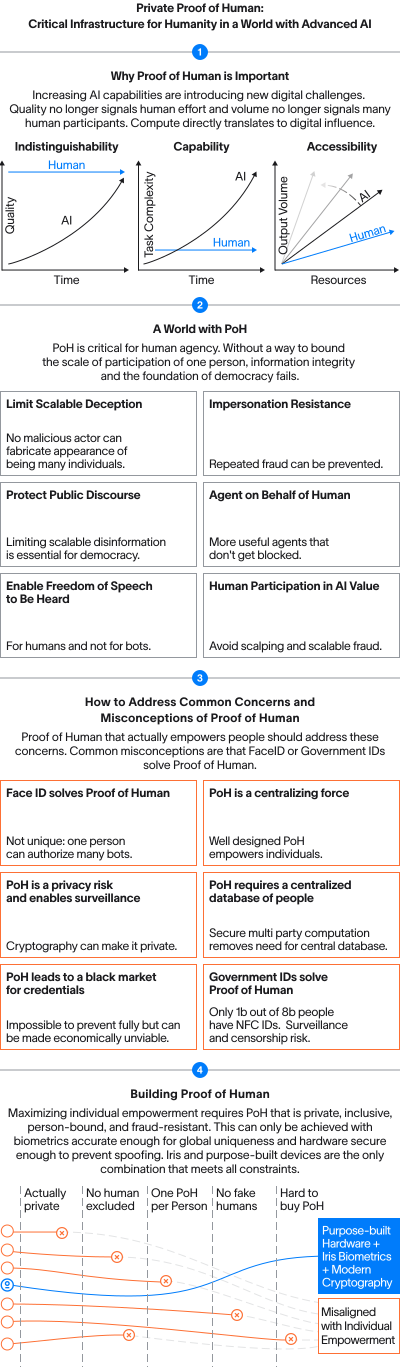
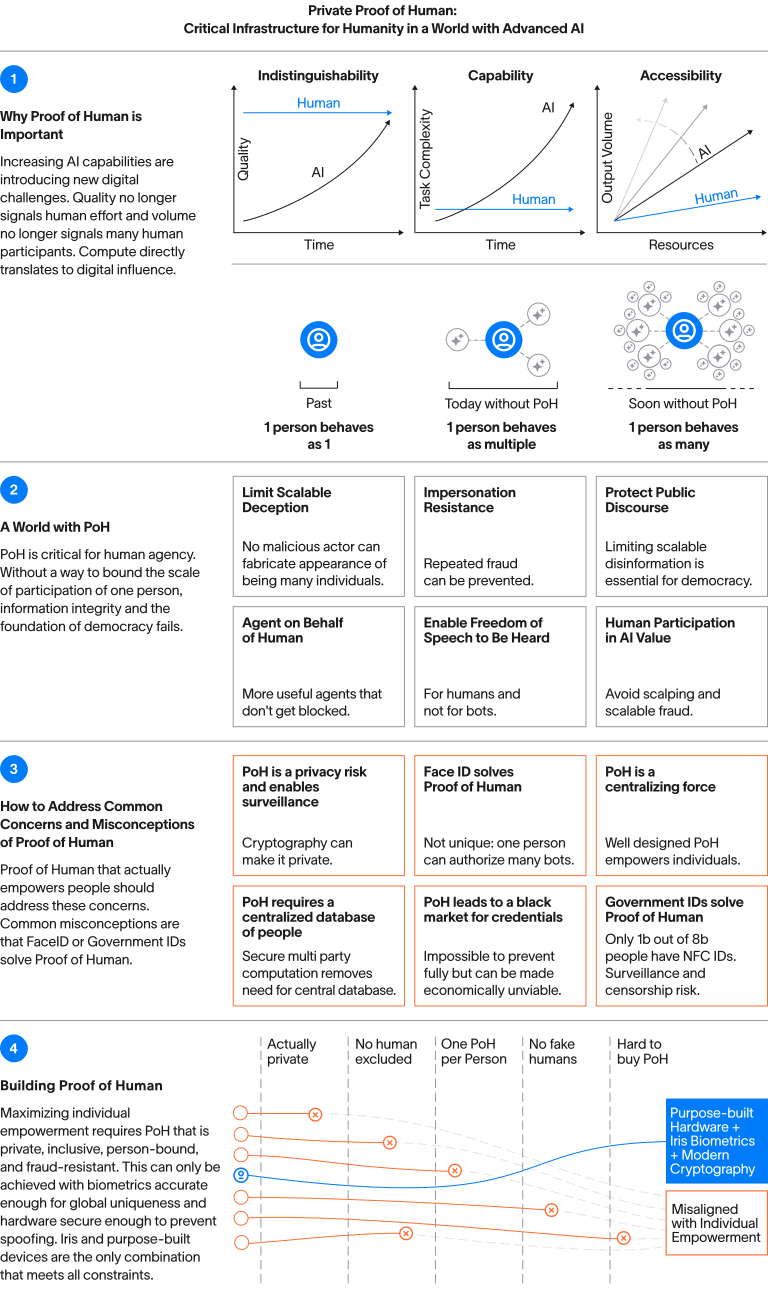
But building PoH is unexpectedly challenging. Government IDs are either ineffective or problematic due to surveillance risks, and face-based methods exclude a large portion of the global population. Creating a surveillance-free and effective solution requires new technology. World is an attempt to build a real human network based on PoH using purpose-built hardware and modern cryptography. We advocate for scaling this infrastructure rapidly to prevent avoidable threats to democracy and avoid less effective, censorship-enabling, privacy-invasive measures that are incentive-misaligned with individual freedom in the long-term.
Bureaucracies tend to address major problems only after significant damage has occurred, which helps focus on what matters most. However, a reactive approach to PoH is highly undesirable. This not only results in avoidable negative consequences but also increases the likelihood of a less considered and simpler implementation, which would likely undermine efficacy, privacy and freedom of speech.
While such infrastructure is unprecedented in scale and extremely difficult to accomplish, the potential upside for humans makes it worth trying. These motivations led to the founding of the World project.
Introducing World
World is the real human network built to accelerate every human in the age of AI. It is based on decentralized PoH that lets people and applications distinguish humans from AI online, combined with an open financial layer that enables anyone to transact and participate in the global economy. At scale, World becomes a trust and financial layer for the internet, strengthening privacy, reducing abuse, and supporting safe, reliable AI adoption.
A Network Built Around People
The goal of World is to create universal means for verifying humanness and a financial layer that uses that verification to enable participation in the global digital economy. It builds a foundation where anyone can prove they are human without compromising their privacy, and transact with anyone else through open, decentralized infrastructure.
The network is built around a few core tenets.
- Proof of human (PoH): PoH is a missing digital primitive that establishes a person is both a real human and unique from other humans. As AI advances, this will become essential infrastructure for establishing trust online.
- User-owned: PoH enables universal access to network ownership for users, so that everyone directly benefits from the network they are creating.
- Incentive alignment: Distributing network ownership encourages participants to join and grow the network until it becomes self-sustaining.
- Scale: The larger the network, the more useful and valuable it becomes to its participants.
The Vision for the World Network
Like Aadhaar and UPI in India enabled over a billion people to authenticate and transact digitally and accelerated progress as a country, World aims to extend that idea globally. But unlike national systems, it is open source, privacy-preserving, and interoperable across jurisdictions.
In the limit, the World Network is not only a programmable financial and identity layer that is native to the internet, but also a decentralized network between people that is foundational to the internet economy in a world with AI.
The World Network consists of five core technologies: World ID, the Orb, World App, World Chain, and Worldcoin (WLD). Where the Orb and World App are the first but likely not the only implementation of their kind. Together, these core technologies form an open ecosystem that grows through community participation and shared benefit.
The World whitepaper series shares the components, reasoning, and implementation of the World project, its current state and its roadmap for the future. This first whitepaper in the series provides an introduction and overview of World, while the others detail specific areas of the project.
Requirements for Proof of Human
The implementation of PoH can take many forms, leading to vastly different societal and individual consequences. These potential outcomes span a spectrum, from intrusive, Orwellian surveillance to systems that safeguard privacy and actively enable free expression. Consequently, the core system architecture, along with the resulting capabilities and incentives for all participants, must be designed with extreme care.
To establish design requirements, we first need to define what we value most. We place the highest importance on individual empowerment because we believe this leads to the most beneficial implementation for human society. This means the design requirements should prevent surveillance, maximize privacy, ensure broad participation and accessibility, and uphold freedom of expression and individual agency.
PoH is still nascent and the thinking around requirements will likely evolve from practical experience as adoption increases. Starting from first principles, valuing individual empowerment above all else leads to the following design requirements:
Inclusive and scalable. It must be feasible for every single human on the planet to participate: across geographies, economic conditions, varying levels of digital literacy, and levels of technical access. A global PoH must be maximally inclusive and accessible to everyone. It should be capable of distinguishing billions of individuals, provide a feasible path to implementation at global scale, and enable participation regardless of nationality, race, gender, age, disability, or economic means. Inclusivity is essential because a PoH that excludes large portions of humanity cannot serve as a universal primitive for trust. Identity systems in the past have often reinforced existing inequities by limiting participation to those with specific credentials, technologies, or forms of access.
Unique and high-integrity. Individuals should be able to acquire exactly one PoH credential, and not more. In order for uniqueness to be effective, the uniqueness verification must be extremely difficult to spoof or bypass.
Person-bound. Credentials must be difficult to sell or transfer at scale; otherwise, uniqueness collapses via a black market for credentials.
Privacy-preserving. Proving that one is a unique human should not require revealing identity, and should support unlinkable use across contexts. While there are many situations where identity is important and useful, there are also many situations where it is important that users be able to interact with one another and with internet services in a pseudonymous or even fully anonymous manner. This must also be possible while differentiating humans from bots, so PoH must be capable of providing users with the ability to interact in an anonymous manner.
Recoverable. If someone loses access to their credentials or their credentials are compromised, they need to be able to recover them. However, if users are managing their own keys, this is a significant challenge because there is no central authority to help restore or revoke keys.
Revocable. In instances where an issuer is found to be compromised or malicious, the impact can be mitigated by removing affected PoH credentials from the list of accepted credentials. If issuance is decentralized across multiple issuing locations and only a subset is affected, the respective subset could be revoked by the issuing authority itself.
Decentralized and open source. Most existing identity systems are centralized and rely on trusted entities such as governments, financial institutions, or global social networks. These models limit inclusivity, introduce potential conflicts of interest, and create systemic risks when the supporting organizations change or fail. A global PoH system capable of supporting the World Network must be decentralized, without any single point of control or failure. It should begin with an open source and clearly defined implementation that promotes transparency and allows anyone to inspect, verify, or build upon the system. The underlying economic model must also be independent and sustainable so that the system can operate without relying on external subsidies or gatekeepers.
Taking the above requirements seriously requires investing in a very sophisticated system, which requires substantial resources to establish but seems likely to lead to the best outcome for humanity. The second whitepaper (Achieving Proof of Human) examines the underlying mechanisms for verifying uniqueness and obtaining a World ID at scale.
Requirements for the Financial Layer
A financial layer for the internet should meet the following key requirements:
Scalability. The network must support high transaction throughput with low latency to enable billions of people to transact seamlessly.
Decentralization. It should be governed and operated through open, permissionless infrastructure that avoids single points of failure or control.
Privacy. Transactions and balances should be secured through cryptographic mechanisms that protect individual data while maintaining the transparency required for network integrity.
Together, these requirements create a financial foundation that is human-centric, resilient, and scalable for the World Network. Today, these remain active work in progress.
Core Components of the World Network
The World Network is built on a set of core components that implement the requirements described above. These include World ID, the Orb, NFC ID credentials, World App and World Chain, each with a distinct function within the ecosystem. Alongside these components, Worldcoin (WLD) serves as the network's native token, which is designed to distribute ownership to all network participants and serve as economic unit of account between actors in the network in the long term.

World ID
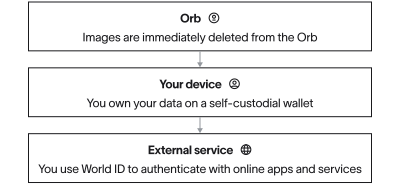
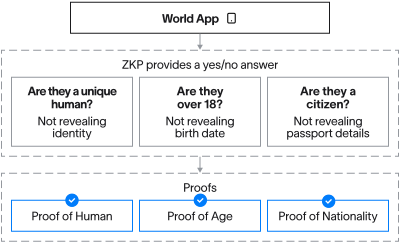
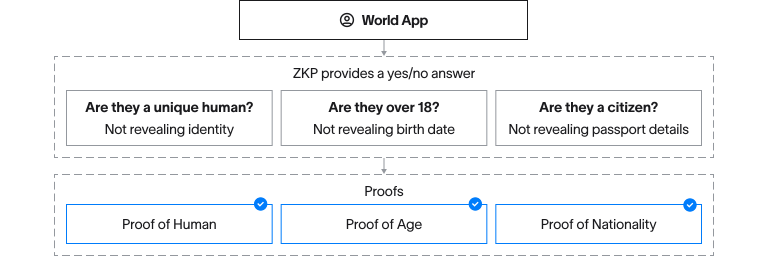
World ID is open source, decentralized infrastructure that enables relying parties to verify credentials of the person they are interacting with, including that they are a real human. Each World ID is designed to be personbound, meaning it can only be used by the individual to whom it was issued. Unlike conventional digital identity systems, World IDs allow individuals to preserve their privacy (including maintaining their anonymity) because the protocol uses personal custody, anonymized multi-party computation (AMPC) and zero-knowledge proofs (ZKP).
The World ID SDK lets any developer directly integrate with the World protocol, so they can both contribute to and benefit from the World Network. The MiniKit SDK makes it easy to build JavaScript web apps that run inside World App. With MiniKit, any web application can request PoH, authentication, and other credentials from World App or other authenticators. Eventually, the Authenticator Kit should also enable developers to integrate their own apps directly as World ID authenticators, giving users more options beyond World App.
Orb
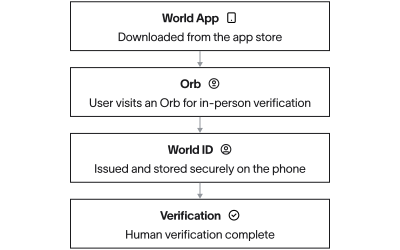
The Orb is a high-security, open source camera that makes it possible to verify you are a unique human without sharing anything else about you. It takes images of your face and eyes, then encrypts and stores them on your phone as a personal custody package so that only you control them. Encrypted, anonymized codes generated by the Orb can then be used by the World protocol to determine that a person is unique and issue a PoH credential. All of this is done simply and easily in a few seconds.
The Orb also produces verifiably human images that are cryptographically signed, creating a new root of trust for the internet. These cryptographically verified signals can strengthen both security and privacy across a range of applications.
- Face Auth builds on the Orb-generated credential to provide privacy-preserving multi-factor authentication. It enables a verified human to confirm that they are taking an action, such as signing in or approving a transaction, adding security without exposing personal data.
- Deep Face also leverages the Orb-generated credential to allow World ID holders to prove that their digital representation, such as a profile photo or live video, matches a real human rather than a deepfake. The verification is done privately, without revealing the original image or identity.

NFC ID Credential
A self-custodial credential is derived from valid government identity documents (starting with ICAO-compliant, NFC chip-enabled passports and national ID cards), enabling people to prove things about themselves online—like their age or nationality—without revealing their identity. This credential introduces a new secure, privacy-preserving way for people to interact online without directly uploading and exposing ID data, helping reduce the risk of personal information being compromised while ensuring individuals meet the requirements needed to keep online platforms free from fraud and misuse.
All ID authentication happens locally on the user's phone and the data remains encrypted, stored locally on the device, and managed within World App. No ID data is uploaded, stored, or shared with TFH, World Foundation or any third party.
World App
World App is the first frontend client to the World Network. It provides a self-custodial wallet that allows users to access financial services on World Chain and manage their World ID credentials. The app guides individuals through Orb verification and uses cryptography to let them prove facts to third parties without revealing their identity. World App also enables developers to connect to the World Network through Mini Apps and access World ID proofs. While it is the first frontend, developers are encouraged to build their own applications and wallets that integrate with the network. The World ID SDK is designed to make this process open and permissionless.

World Chain
World Chain is the financial layer of the World Network. It is designed to function as an open, human-centered financial system.
World Chain is implemented as a layer-2 network on Ethereum and is built on the Superchain architecture, which supports high throughput and low-latency transactions. By combining decentralized execution with human-based prioritization, World Chain establishes the financial layer that powers PoH and adds decentralized security to the broader infrastructure of the World Network.
Worldcoin (WLD)
WLD is the native digital currency of the World Network, designed to become the most widely used and accessible form of value exchange in the world.
Ownership of WLD represents a proportional share in the value created by the World Network. Unlike traditional platforms where value accrues to a small number of centralized entities, WLD enables decentralized ownership by distributing tokens to verified participants through PoH credentials in World ID. This model ensures that everyone contributing to or participating in the network can share in its success, aligning incentives for growth, sustainability, and responsible governance.
The issuance of WLD is governed by smart contracts that transparently manage on-chain distribution, fees, and incentives (certain distributions are currently administered by the World Foundation). This structure allows the World Network to evolve as a self-sustaining ecosystem that resists centralized control and stays aligned with the interests of its global community.
For further details refer to the Decentralization whitepaper and on the supply model and network fees, see the supply and fees blog posts.
Applications and Impact
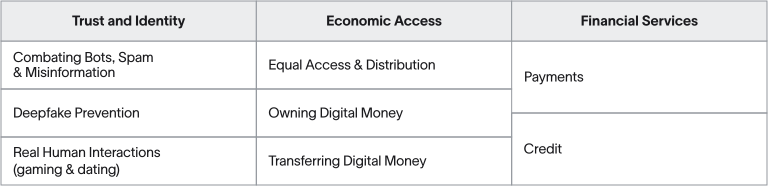
World has the potential to expand equal opportunity worldwide by enabling anyone, regardless of location or socioeconomic status, to participate in the global digital economy. Through universally accessible, decentralized infrastructure, World lowers barriers to access, allowing more people to connect, transact, and create value online. As more verified users join, the network becomes more valuable, which strengthens what already exists and unlocks entirely new applications that rely on a trusted PoH credential.
Economic Access
Billions of people still live outside the global economy. Even for those included, moving money remains slow and expensive. World Chain connects people through a shared financial layer that works at internet scale. Inside World App, Mini Apps already let users hold digital money, exchange assets, and use fast, low-cost financial rails. The Morpho Mini App, which brings decentralized lending to verified users, shows how human verification can make DeFi safer and more inclusive.
Examples like the COVID Crypto Relief fund for India, which raised over $400 million in digital assets, show how decentralized networks can coordinate and distribute resources globally. World builds on that idea and makes it accessible to everyone. This same infrastructure could one day connect billions through a unified, human-centered network for value exchange.
Whether AI will create the need for broad redistribution systems, such as benefits for impacted individuals, universal basic compute, or comparable per-person allocations, is highly uncertain. However, if such mechanisms become important, there is currently no infrastructure capable of supporting this on a large scale without catastrophic failure modes–especially if it crosses geographical borders. Any system that distributes resources per person is immediately vulnerable to Sybil attacks. Without a reliable way to identify unique humans, redistribution collapses under unlimited duplication and resource drain.
Trust and Identity
Verifying humanness privately introduces a new layer of integrity to the internet. By enabling a way to constrain the number of accounts any one individual can create, PoH can directly address scalable deception at its core. Limiting the number of accounts makes artificial amplification of messages and manufactured appearance of broad consensus much more expensive and ideally uneconomical. This significantly reduces the reach and impact of disinformation campaigns. Furthermore, this limitation allows existing mechanisms—such as content provenance, moderation, community notes, and polls—to function as they were intended.
The same participation constraint directly limits large-scale fraud and impersonation. Attacks like phishing, account selling, benefits fraud, and identity theft all rely on the ability to cheaply multiply identities. By enforcing per-human access limits, PoH makes these attacks difficult to scale. This is achieved without the need for continuous behavioral monitoring or cross-service data correlation. Consequently, systems can effectively prevent reply bots, reduce rapid re-entry after a ban, and limit the resale of high-influence accounts while still preserving pseudonymity and avoiding persistent surveillance.
Verification also strengthens protection against deception, which is becoming more important as deepfake technology continues to make impersonation increasingly convincing and easy. Many PoH implementations naturally support the creation of locally held (on the user's phone), signed selfie pictures taken during the initial verification. These selfies can be used to sign messages, images, or video streams as originating from a particular human. While this does not detect AI-generated content, it significantly raises the cost of impersonation, in much the same way that two-factor authentication reduces account takeover risk without proving intent. Essentially someone can prove that a particular video stream was authorized by someone that actually looks like the person in the video stream. This makes it very hard to impersonate someone because it is very hard to obtain an authentic signed face picture of someone (assuming the PoH issuer has good security) and then also spoofing a real-time local faceID-like authentication challenge. Applications include authenticating participants in video conferencing, signing emails, and verifying profile pictures and social interactions between individuals. Tools like Deep Face, a Mini App that uses World ID authentication, can accurately confirm that a video or image originates from a real human while keeping identity private.
Practical uses are already emerging. For example, World ID's partnership with Match Group enables age verification on Tinder in Japan, helping users connect safely while maintaining privacy. In gaming, verified human credentials such as Razer ID with World ID support fair play and stronger community standards as AI agents begin to appear in all types of online games.
Prevent Scalable Disinformation and Protect Public Discourse
PoH is essential for enabling authentic public discourse in a world where humans and bots are difficult to distinguish. By preventing bad actors from scaling misinformation and manufacturing the appearance of widespread support for specific beliefs or events, PoH safeguards the integrity of human participation in online opinion formation.
A public "town square" depends on people forming opinions based on engagement with other human participants. When humans cannot be distinguished from bots, individual contributions are harder to surface, and people may give up expressing their opinion when they assume most participants are bots. PoH empowers individuals and enables public debate by elevating human voices above automated noise.
At the same time, as AI lowers the cost of aggregation and analysis, collecting large-scale human input becomes more feasible than before. For governments, this makes real-time policy input more efficient. PoH ensures that such participation can be trusted to come from real people and not bots.
Agent on Behalf of Human
As AI agents become more capable, an increasing share of human-like online activity will originate from bots rather than from humans. Communication, coordination, and economic actions will often be carried out asynchronously, at high frequency, and over long horizons by systems acting on someone's behalf.
To enable the same benefits PoH creates for human-to-human interaction, agent-mediated activity also needs to be anchored to real humans. This can be implemented as revocable delegation of someone's PoH to an agent. Actions taken by an agent can therefore be verified as occurring on behalf of a human, even when the execution is automated. Importantly, this does not enable someone to delegate PoH to a large number of bots — it preserves the core property of PoH: participation and influence are human-bounded and therefore rate-limited.
Financial Empowerment
Programs that depend on human participation like incentives, research studies, or loyalty rewards can operate without being distorted by bots or duplicate accounts. The TBD.vote Mini App enables this by letting unique participants receive rewards for sharing their feedback and opinion without exposing personal data, producing better information and fairer outcomes.
PoH also redefines how credit can function. Instead of depending on collateral or opaque scoring models, lenders can extend credit to verified humans through secure, privacy-preserving credentials. The Credit Mini App is an early example of this, showing how lending can become more accessible and accountable.
Looking Forward
World was conceived with the mission of building the real human network to accelerate humans in the age of AI. PoH, the foundation of the World Network, introduces a new digital primitive that can redefine how people interact and transact online. By enabling applications and services that are inherently human-centric, such as Mini Apps that integrate privacy-preserving human verification and finance, PoH makes a new class of interactions possible — built on trust, authenticity, and universal access.
Such infrastructure is unprecedented in both scale and complexity. There are many challenges that could prevent its success.
- Scale: Public resistance to biometric verification or the logistical complexity of deploying verification hardware worldwide could impact the project's scale.
- Equitable access: Barriers related to geography, regulation, technology, or cost could create unequal access and undermine the goal of universal participation.
- Governance and incentives: Misaligned incentives or concentration of ownership could distort participation and reduce the effectiveness of decentralized decision-making.
- Security: The system may be vulnerable to technical failures, security breaches, or other unforeseen errors.
There are also risks that demand continuous attention. If implemented poorly, systems like PoH could threaten privacy, limit free expression, or concentrate control. To guard against these outcomes, World is being developed in the open, with transparency, distributed issuance, and privacy as core design principles.
Recognizing PoH as critical infrastructure still requires a meaningful shift in public perception which is likely the biggest limiting factor for proactive adoption and safeguarding humans in a world with advanced machine intelligence. Although awareness of scalable automation is increasing, PoH is usually framed as a narrow anti-bot measure rather than as a foundational layer for human coordination and societal stability. Misconceptions around surveillance and privacy that conflate privacy-preserving uniqueness verification with centralized identity systems that collect and monitor personal data slow down adoption. At the same time, AI capabilities continue to advance in both scale and coordination, and as machine capabilities compound, the absence of widely adopted, high-integrity PoH becomes more consequential. Adoption must accelerate in parallel with AI progress.
The remaining whitepapers in this series outline the current thinking on how to design and evolve the World Network so that it becomes a durable and beneficial piece of global infrastructure for humanity.
Other Resources
The World roadmap is a dynamic and evolving blueprint that is subject to change and refinement through input and decisions from the World community. Whether you are a developer, a user, an enthusiast or simply someone interested in the future of decentralized systems, please reach out through the appropriate channel:
- Join the community discussion on X or Discord.
- Contribute to open source repositories on GitHub.
- Visit the World developer documentation.
- Reach out directly to the World team for support questions.
- View live on-chain data on the Dune dashboard.